Walk around any neighborhood in Streetsboro after a windstorm and you will see the same scene play out. A few broken branches, a leaning trunk, maybe a large limb resting a little too close to a roof. By late afternoon, someone has a ladder out, a chainsaw in hand, and a family member filming from the driveway. That is usually the moment when people who work in professional tree service start to feel nervous.
From a distance, tree removal looks straightforward. The tree goes up, you cut it at the bottom, it comes down. In practice, it is one of the more complex and unforgiving jobs around a home. I have seen homeowners do a clean, careful job on a small ornamental tree. I have also seen a single bad cut fold a main branch through a roof, rip down utility wires, and leave a healthy person with a permanent limp.
Streetsboro, with its mix of older trees, clay-heavy soils, and tight residential lots, adds several layers of risk that people do not always see until it is too late.
This is an inside look at why DIY tree removal here can be dangerous, where the real hazards hide, and how to think through whether to call a professional tree service in Streetsboro instead of tackling it alone.
Why tree work feels easier than it is
Most people are comfortable with basic yard work. Mowing, raking, light pruning, maybe a bit of tree trimming with a pole saw. That familiarity can blur the line between routine maintenance and work that belongs in a different category.
A few reasons tree removal often gets underestimated:
First, trees look static and predictable. They seem rooted and solid, so it is easy to assume they will fall the way you plan. Second, consumer-grade chainsaws are widely available and powerful, which gives a sense of capability that may not match real training. Third, when you see professional crews handle large removals smoothly, it can create an illusion that the work is simply a matter of equipment, not skill and judgment developed over years.
The core problem is that once you start cutting, the tree stops being a fixed object and starts behaving like a loaded spring. Its weight, internal tension, lean, wind exposure, and decay patterns all begin to interact. When something goes wrong with that interaction, it happens very fast.
The physics you do not see from the ground
On paper, a tree is just height and diameter. In reality, it is an uneven mass of wood, water, and stress. A typical medium-sized oak in a Streetsboro yard can easily weigh several thousand pounds. Even a "small" 12 inch trunk can carry enough weight to crush a vehicle or punch through a roof.
Some of the most dangerous factors are invisible until the cut is made.
Branches and trunks carry internal tension and compression. When wind loads a tree for years, fibers stretch on one side and compress on the other. That stored energy does not show up in a visual inspection. It shows up when a cut releases it and the wood snaps, twists, or kicks.
Leaning trees, in particular, can surprise people. A common DIY assumption is, "It leans that way, so it will fall that way." Sometimes it does. Sometimes root structure, crown weight, or wind direction alter tree service that path at the last second. A small change at the base can mean a 2 or 3 foot shift in the landing zone at the top, which is enough to catch the corner of a roof or clip a service line.
Even branches that look dead can react unpredictably. Dry, decayed limbs can shear off earlier than expected, falling directly onto anyone working below. Professionals plan for these failures by staging cuts from safer positions and keeping their bodies out of obvious fall zones. A homeowner standing on a ladder with a chainsaw rarely has that margin.
Streetsboro specific risks: soil, wind, and lot layout
The local setting matters. Tree removal in wide open rural fields is one thing. In Streetsboro’s typical subdivisions and older streets, you deal with tight spacing, overhead services, and soil that behaves differently across seasons.
Clay-heavy soils like we see in much of Portage County do not anchor roots the same way as deep, loamy ground. Trees that have stood for decades can lose stability after a wet spring, a freeze-thaw cycle, or nearby construction. When you start cutting roots or removing weight from one side of the crown, the whole tree can shift unexpectedly in that softened soil.
Wind also matters. Our area does not see coastal storms, but we do get strong gusts and the kind of sudden microbursts that turn an already marginal tree into a hazard. A half-cut trunk in a gust is one of the worst positions to be in. That is when barber chair failures happen, where the trunk splits vertically and a large slab of wood drives backward toward the saw operator.
Lot layout in many Streetsboro neighborhoods complicates that picture. Trees often sit close to homes, fences, sheds, or shared property lines. A ten degree error in fall direction can be the difference between a clean drop in an open yard and your neighbor’s vinyl siding catching a direct hit.
Professionals in tree removal in Streetsboro work around these constraints daily. They use ropes, pulleys, friction devices, and sometimes cranes to lower sections in tight spaces. Without that gear and experience, a homeowner is left with gravity and guesswork.
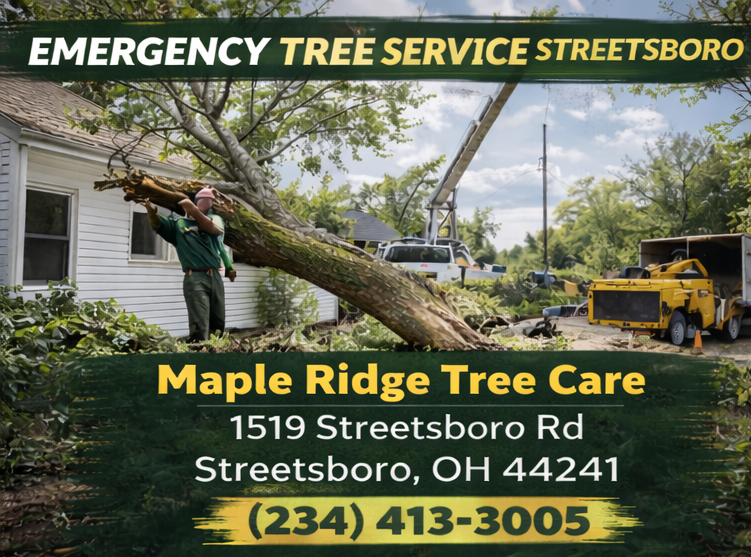
Chainsaws, ladders, and protective gear
Most of the serious injuries in DIY tree work involve some mix of chainsaws and ladders. Neither one is forgiving if something goes wrong.
Chainsaws demand more than a basic read of the instruction manual. Kickback, pinch, and bind happen fast. The saw can leap toward the operator’s face or legs in a fraction of a second. Professionals dress for that possibility, not for comfort. Chainsaw-resistant chaps, helmet with face shield, hearing protection, steel-toe boots, and gloves are standard for any serious tree service crew.
Very few homeowners dress that way for a quick weekend project. Shorts, sneakers, bare arms, and no eye or face protection are common. The difference between a glancing cut and a life-threatening one is often a couple layers of specialized fabric.
Ladders multiply the risk. When you cut above shoulder height from a ladder, you are dealing with:
A moving tool with kickback potential. A rung that might shift in soft ground. A branch that might react differently than expected.That combination is why professional tree trimming and removal seldom rely on ordinary extension ladders for serious cutting. Climbers use ropes and harness systems designed to keep their center of gravity stable and their feet secure on the trunk, not on an aluminum rail planted in turf.
When you see a crew from a tree service like Maple Ridge Tree Care working aloft, you will notice redundancy in their setup. A primary climbing line, a secondary lanyard, multiple anchor points. It may look slow from the driveway, but it is built around the fact that gravity never negotiates.
Hidden structural defects in trees
From the ground, a tree can look solid. Bark intact, crown mostly full, only a bit of deadwood. Inside, it can be a different story.
Common hidden issues include internal rot, hollow trunks, and advanced fungal decay at the base or in critical junctions where large limbs attach. Trees can compartmentalize decay for years, silently losing structural integrity until a cut or a strong gust pushes them past the point of stability.
I have seen trunks that sounded solid with a quick knock turn out to be thin shells of wood around a hollow core. When a saw cut enters that shell, the weight of the crown can buckle it suddenly. Instead of falling in a controlled hinge, the entire upper section collapses almost straight down, sometimes twisting as it goes.
Professionals are trained to read subtle clues: bracket fungi on the trunk, unusual swelling or cracking near the base, seams along major limbs, cavities hidden behind old wound closures. Even experienced arborists misjudge a tree now and then, which is why they build escape routes and rigging redundancies into their work.
A homeowner who judges a tree as "solid" based on a quick walk-around is rolling the dice with a lot of mass overhead.
Power lines and utilities: closer than they look
One of the most common comments before a mishap is, "The lines are not that close." Overhead service drops and secondary lines often run exactly where tree crowns have grown out over decades. Your perspective from the ground can be misleading.
Contact with power lines does not require a branch to rest neatly across a wire. Electricity can arc, and even near contact can energize moisture, sap, or wet foliage. A homeowner on a ladder touching a branch that touches a line is a recipe for electric shock.
Utilities in Streetsboro are a mix of overhead and underground. Cutting roots near buried gas or water lines can also create problems, especially if excavation has already disturbed the area. Heavy sections of falling wood can damage above ground meters or disconnects without direct line contact.
Professional tree service crews work under strict clearance rules around energized lines. For work within specific distances, utility coordination or certified line-clearance arborists are required. That is not a paperwork formality. It is a recognition that electricity and wet wood are a bad combination for amateurs.
Liability, insurance, and the cost of a mistake
Property damage from DIY tree removal usually falls into two buckets: hitting your own structures or damaging someone else’s. Both can get surprisingly expensive.
A direct strike on a roof can mean more than replacing a few shingles. Broken rafters, compromised trusses, and water intrusion can push repair costs into the tens of thousands. If a falling trunk hits a deck, pool, or vehicle, the bill climbs quickly.
When the damage crosses a property line, things get more complicated. If your cut drops a limb through a neighbor’s fence or garage, your homeowner’s insurance may cover some or all of it. It may also raise your premiums, and the process can strain that neighborly relationship.
In some cases, insurance companies scrutinize whether the work involved reasonable care or clearly exceeded a homeowner’s capabilities. If a claim reviewer sees ladder chainsaw work high in the crown of a large maple, they may take a harder line.
Professional tree removal in Streetsboro typically comes with liability insurance. A reputable tree service carries coverage that protects both the crew and the property owner if something goes wrong. When you price a job from a company like Maple Ridge Tree Care, part of what you are paying for is that financial buffer, not just the time and equipment.
The hidden cost of DIY is not just the risk of injury. It is the potential financial hit if the job goes bad in a crowded neighborhood.
When DIY can be reasonable, and where the line should be
Not every tree-related task requires a professional. There is a spectrum of work around a property, and homeowners can safely handle some of it, provided they are honest about their limits.
Reasonable DIY tasks usually include very small trees that can be safely pushed over by hand once cut, low branches that can be trimmed from the ground with a pole saw, and cleanup of small broken limbs already on the ground after a storm.
The line should start to appear when any of the following are involved:
A tree taller than your house or close enough to hit it if it falls.
Cuts that require standing on a ladder with a chainsaw or heavy saw above shoulder height.
Branches or trunks near power lines, service drops, or main roads.
Visible decay, large dead sections, or lean toward a structure.
Tight drop zones where there is no open ground for the tree to fall without hitting something important.
The more of these factors you stack together, the more the work moves into professional territory. It is not about skill pride. It is about the physics of height, weight, and limited reaction time.
How professionals manage risk differently
Watching an experienced crew from a tree service in Streetsboro work on a large removal can look almost routine. What you are seeing is the surface of a process structured around risk control.
Before the first cut, a good crew walks the site and looks up, not just at the trunk in front of them. They check for dead tops, hung-up branches (widowmakers), nearby lines, weak unions where major limbs meet, and ground conditions around the root flare. They think through escape paths, where their ropes will run, and how each section will be lowered.
Instead of dropping an entire tree in one shot, they typically work top down, removing limbs in a controlled sequence and lowering heavy sections with rigging. That changes a single large impact into a series of manageable movements. It also allows them to steer wood around roofs, fences, and landscaping.
The equipment they use is part of that risk management: tuned saws sized to the job, aerial lifts when needed, friction devices to control descent, and communication tools like clear hand signals and radios. Just as important, they work with clear roles and a chain of command. One person directs the action, others follow, and no one stands in a fall zone out of habit.
Tree work always carries risk, even for professionals. The difference is that a skilled crew’s entire system is built to keep that risk within a narrow, controlled band.
Choosing a tree service in Streetsboro with judgment, not just tools
If you decide not to tackle removal yourself, the next choice is who to hire. Around Streetsboro, you will see plenty of trucks with chainsaws in the bed. Not all of them bring the same level of training or insurance.
A few practical signs that a tree service takes safety and quality seriously:
They carry proof of liability insurance and are willing to show it before work starts.
Their estimate addresses how they plan to protect nearby structures, fences, and landscaping.
You see appropriate protective gear on the crew, not just the person with the saw.
They ask about underground utilities, septic systems, and access routes for equipment.
Their plan for the job includes controlled lowering of sections when the space is tight, not just "We will drop it right there."
Maple Ridge Tree Care and other established providers of tree removal in Streetsboro tend to check these boxes because they have learned, sometimes through hard experience, what happens when shortcuts are taken. That learning is part of what you buy when you hire them.
Price matters, but so does how a company talks about the work. If their focus is only on https://oh-state.cataloxy.us/firms/oh-streetsboro/streetsborotreeservice.com.htm how fast they can be there and how cheap they can do it, without talking through the details of your particular tree and site, that is a red flag.
The emotional pull of DIY and how to think past it
There is a real satisfaction in solving problems around your own property. Cutting down a troublesome tree can feel like a test of competence. I have met plenty of people who are capable with tools, have construction or mechanical backgrounds, and take pride in handling their own repairs.
That confidence is valuable in many areas. With tree removal, it can also be a trap. The human brain is bad at intuitively grasping risk when outcomes are rare but severe. You might get away with shaky practices several times, which reinforces a sense that they are safe. Then one day, nothing is different except the angle of a cut or the way the wind gusts, and the result is a close call or worse.
A useful way to think about tree work is in terms of stakes, not just difficulty. Ask yourself:
If something goes wrong, what is the worst plausible outcome here?
Could this job injure me badly enough that I cannot work for a while?
Could a mistake damage my home or a neighbor’s beyond what I can easily afford to fix?
If the honest answers are "serious injury is possible" or "damage could be significant," that is usually a signal that a professional tree service should at least give you an estimate. You can still decide no, but you will have a clearer picture of what is involved.
Final thoughts on staying safe around trees in Streetsboro
Trees add a lot to properties in Streetsboro. Shade that knocks a few degrees off summer bills, privacy, color in fall, wildlife. Living with them also means occasionally dealing with dead limbs, storm damage, or removals when a tree becomes unsafe.
There is nothing wrong with wanting to handle straightforward work yourself. Pruning a few low branches or clearing small storm debris is part of normal property care. The danger comes when a chainsaw, a ladder, gravity, and many hundreds of pounds of wood all show up in the same scene near a house or power line.
At that point, the job is less like mowing the lawn and more like light construction on an unstable structure. The skills and tools that professional tree trimming and removal crews bring to the job exist because the risks are real, not theoretical.
If you are unsure where your situation sits on that spectrum, that uncertainty itself is useful information. Reaching out to a local tree service in Streetsboro, whether Maple Ridge Tree Care or another reputable provider, for an assessment does not obligate you to hire them. It does, however, give you a clearer sense of what safe removal or trimming would look like on your specific property.
The bottom line is simple. Wood and gravity always win arguments. The smartest thing a homeowner can do is decide which battles to fight with their own hands, and which ones to hand off to people who manage that fight every day.